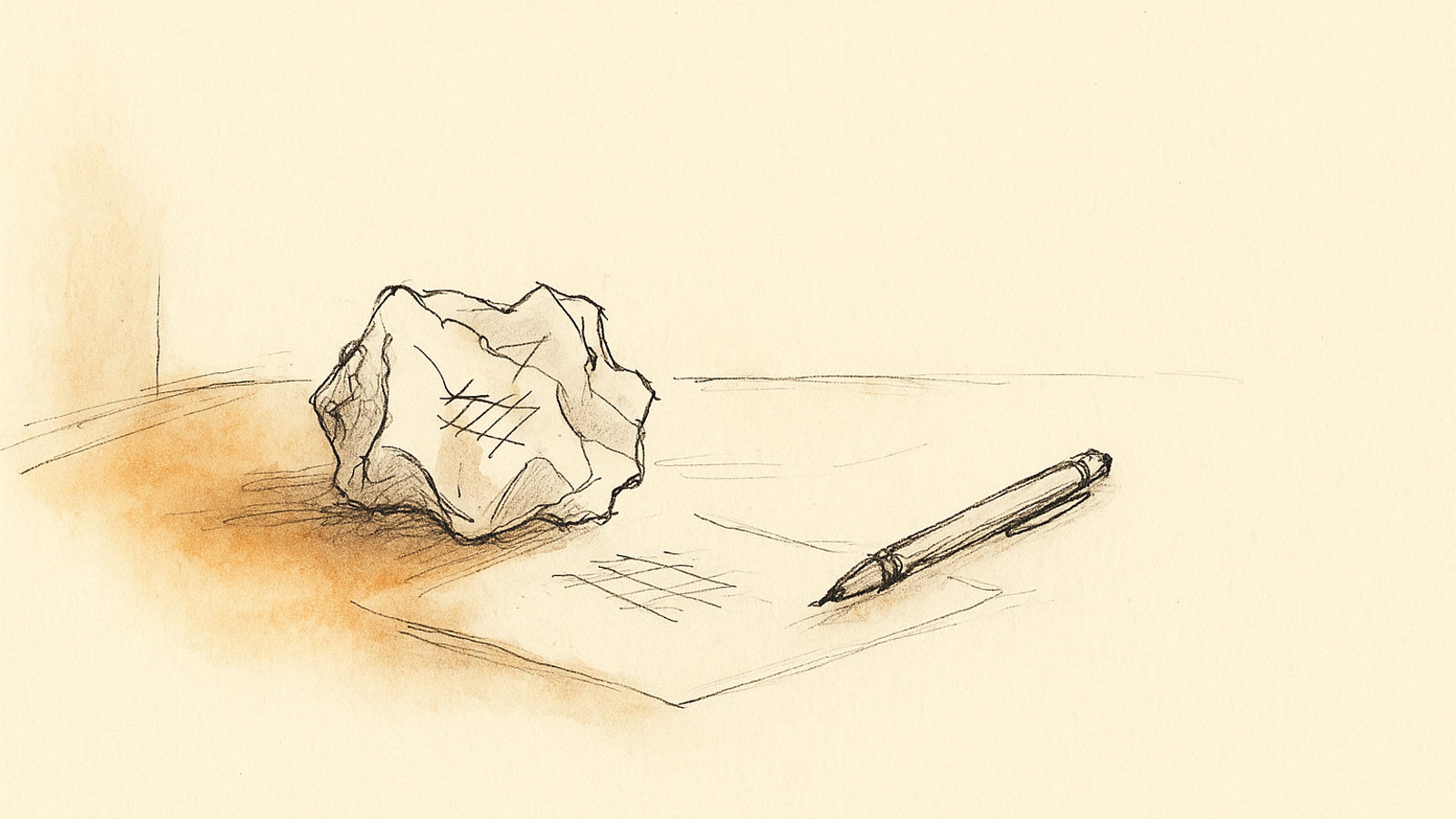

You know the feeling. It’s Sunday night. You sit down with a fresh notebook (or a fresh app — you’ve tried them all) and write out everything you need to do this week. By the time you’re done, the list is 47 items long and you already feel behind.
Monday morning arrives. You open the list. You stare at it. You close the list. You check your email instead.
This isn’t a discipline problem. It’s a design problem. And there’s a growing body of research that explains exactly why your to-do list is working against you — and what to do about it.
The Uncomfortable Truth About To-Do Lists
Let’s start with a number that should make every productivity enthusiast uncomfortable.
of to-do items are never completed
iDoneThis, analysis of user task data (2015)
That’s not 41% of ambitious stretch goals. That’s 41% of everything people write down with the genuine intention of doing. Nearly half of all to-do items get pushed forward, rescheduled, and eventually deleted — or worse, left sitting there as a monument to good intentions.
The natural response is to blame yourself. You weren’t focused enough. You weren’t disciplined enough. You need a better system, a better app, a better morning routine.
But what if the problem isn’t you? What if it’s the list itself?
What the Research Says
In 2011, psychologists E.J. Masicampo and Roy Baumeister published a study that quietly changed how we should think about task management. Their finding was counterintuitive and, for anyone drowning in to-do items, profoundly hopeful.
Consider It Done! Plan Making Can Eliminate the Cognitive Effects of Unfulfilled Goals
Masicampo, E.J. & Baumeister, Roy F. (2011) · Journal of Personality and Social Psychology
Key finding: Unfulfilled goals cause intrusive thoughts that impair cognitive function (the Zeigarnik effect). But making a specific plan for when and how to complete a goal eliminates this cognitive interference — even though the goal remains unfinished.
Download PDFRead that finding again. You don’t have to do the task to free your mind from it. You just have to make a specific plan for when and how you’ll do it. The act of planning itself resolves the cognitive tension.
This is the Zeigarnik effect in action — the phenomenon where incomplete tasks occupy working memory, creating a background hum of anxiety that degrades your ability to focus on anything else. Your brain treats unfinished business like an open browser tab, constantly pulling resources even when you’re trying to concentrate on something else.
The traditional to-do list makes this worse, not better. It takes all of your open loops and puts them in one place where you can see exactly how many tabs are open. No wonder looking at a long list produces more anxiety than motivation.
The Three Failures
Failure 1: The Planning Fallacy
The planning fallacy is a tendency to underestimate the time, costs, and risks of future actions and at the same time overestimate the benefits of the same actions.
Kahneman and Tversky identified this bias in 1979, and decades of research have confirmed it: humans are systematically terrible at estimating how long things take. We consistently underestimate by 25-50%.
When you write “clean the garage” on your to-do list, your brain files it as a 30-minute task. In reality, it’s a four-hour project. Multiply that optimism bias across 30 items and you’ve built a list that would require 60 hours to complete in the 8 hours you have available. You haven’t planned a day — you’ve planned a fantasy.
Failure 2: No Prioritization
A flat to-do list treats “respond to urgent client email” the same as “look into that podcast someone mentioned.” Everything sits at the same level, which means everything competes for your attention equally.
By mid-afternoon, when your cognitive reserves are depleted, you’re faced with a wall of undifferentiated tasks. The psychological term for what happens next is decision fatigue — and Baumeister’s research shows it’s not just feeling tired. Your brain literally starts making worse decisions, defaulting to the easiest option or doing nothing at all.
Failure 3: Collection Without Commitment
Most to-do lists are collection tools, not commitment devices. They capture everything you might need to do without forcing you to decide what you will do, when you’ll do it, and how long it will take.
This is the critical gap Masicampo and Baumeister identified. Writing “call the dentist” on a list doesn’t close the cognitive loop. Your brain keeps nagging you because you haven’t specified when you’ll call. But “call the dentist at 10:15 AM, between the standup and lunch” — that’s a plan. That’s what quiets the mental noise.
The Science of Getting Things Done
Charles Duhigg, author of The Power of Habit and Smarter Faster Better, has spent years studying the intersection of neuroscience and productivity. His take on why traditional lists fail is worth watching:
The research converges on a concept psychologists call implementation intentions — specific if-then plans that tie an action to a time, place, or cue. Meta-analyses by Peter Gollwitzer show that implementation intentions increase the likelihood of goal achievement by roughly 2-3x compared to simple goal-setting.
In other words: “I will exercise” is a wish. “I will run for 30 minutes at 7 AM before my shower” is a plan. And plans work where wishes don’t.
A Better Way: The Morning Planning Ritual
So if flat lists don’t work, what does? The research points to a deceptively simple practice: a brief daily planning session, done first thing in the morning, that converts your collection of tasks into a prioritized, time-blocked, realistic plan for the day.

The transformation isn’t magic. It’s just applying what the research tells us:
- Review everything — look at all your projects, commitments, and open loops in one place. This is where the Zeigarnik effect gets managed.
- Estimate honestly — assign real time estimates to every task. This combats the planning fallacy.
- Prioritize ruthlessly — order by importance, not urgency. Your future self at 3 PM will thank you.
- Cut the excess — if your list requires 14 hours and you have 6, something has to go. Better to choose now than to fail by default later.
- Commit to the plan — your list becomes a sequential queue. Work the next item. Don’t browse.
The 15-minute morning planning session works because it front-loads the hardest cognitive work — prioritization and estimation — to the moment when your brain is best equipped to handle it. For the rest of the day, you’re just executing a plan, not making decisions.
Common Questions
I already use a productivity app. Won't this just add another step?
Most productivity apps are sophisticated collection tools — they help you capture and organize tasks, but they don’t do the cognitive work of prioritizing, estimating, and building a realistic daily plan. The morning planning ritual isn’t another app. It’s the 15-minute practice that makes any app actually work. Think of it as the operating system that runs on top of whatever tool you use.
What if something urgent comes up and blows up my plan?
It will. Every day. The point of the plan isn’t to predict the future perfectly — it’s to have a baseline to return to after the interruption. Without a plan, an urgent email at 10 AM derails your entire day because you have no anchor. With a plan, you handle the email and go back to item #4 on your list. The plan survives interruptions precisely because it reduces the decision cost of getting back on track.
I've tried morning routines before and they never stick. What's different?
Two things. First, the planning fallacy applies to habits too — you’re probably trying to build a 90-minute morning routine when a 15-minute focused planning session would be more effective and sustainable. Second, the research on habit formation shows that complexity kills consistency. A planning ritual that requires you to review 6 apps and 3 dashboards won’t survive contact with a bad night’s sleep. The simpler the ritual, the more durable it becomes.
Does this mean I should throw away my to-do list?
No — collection is still important. You need a place to capture everything so it’s not bouncing around in your working memory. The mistake is treating the collection as the plan. Capture everything, then each morning, pull from that collection to build a realistic daily commitment. The collection is your library. The daily plan is the book you’re actually reading today.
The Bottom Line
Your to-do list isn’t failing because you lack discipline. It’s failing because it was never designed to work the way you’re using it. A flat, unprioritized, unestimated collection of tasks triggers more anxiety than it resolves, and the science explains exactly why.
The fix isn’t a better app or a better system. It’s a practice: 15 minutes each morning, converting your backlog into a realistic, ordered plan for the day. It’s the simplest change with the highest return on investment in all of productivity science.
And if you want a tool that does the heavy cognitive lifting for you — reviewing your projects, challenging your priorities, estimating your time, and handing you one clean list — that’s exactly what ThinkDone was built to do. A 15-minute AI planning meeting every morning. No organization required. Just a conversation and a plan.
Because done is the engine of more.
Keep Reading
The Complete Guide to Getting Things Done (GTD): David Allen's System Explained
David Allen's Getting Things Done has sold over 2 million copies and influenced every productivity system since 2001. Here's the complete guide to GTD methodology, the cognitive science that explains why it works, and how AI is transforming Allen's vision for the 21st century.

Best AI Productivity Apps in 2025: 9 Tools That Actually Think For You
We tested every major AI productivity app. Here's what nobody's talking about: which ones actually use intelligence to plan your day, and which ones just slapped GPT into their settings menu and called it AI.

Asana: The Enterprise Planning Powerhouse That Changed Team Productivity
Asana transformed from Facebook's internal coordination tool into the enterprise project management platform trusted by 130K+ organizations. This deep-dive reviews Timeline, Portfolios, Workload, Goals, and the brutal truth about when Asana is overkill versus when it's essential.